Dr Anna Griffin | September 2026
Start Skills in the Age of AI: Communication, teamwork, critical thinking, problem solving – the four things AI cannot do for you, and what employers say about how graduates are doing at them.
Start with the question everyone is aksing
If AI can write the code, run the analysis and draft the report, what is left for you?
The World Economic Forum tested this directly. Its Future of Jobs Report 2025 assessed more than 2,800 individual skills for how readily current generative AI could substitute for a human performing them. Not one was rated as having a very high capacity for substitution. Around 69 per cent were rated very low or low. And the skills with no substitution potential at all were the human ones — empathy and active listening among them.
At the same time, employers expect 39 per cent of workers’ core skills to change by 2030.
Read those together and the answer is uncomfortable but useful. The technical half of your work is the half most exposed to change. The human half is the half that holds its value.
The four skills we mean
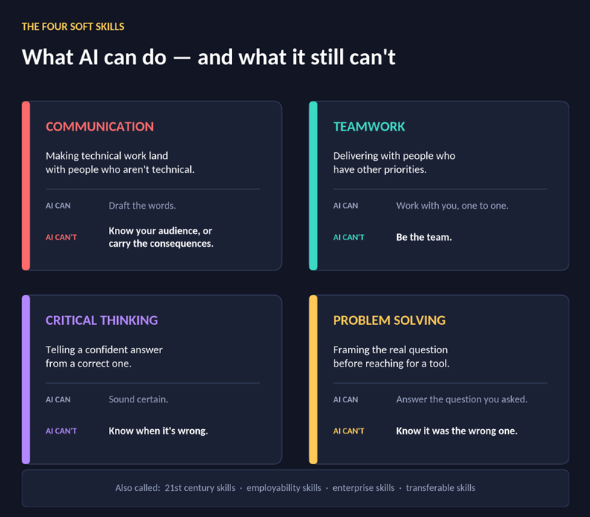
You will hear these called soft skills, 21st century skills, employability skills, enterprise skills or transferable skills. Different frameworks, same four things: communication, teamwork, critical thinking and problem solving.
AI makes these harder, not easier
The intuition is that AI takes work off your plate. The research suggests it changes the work instead — and raises the bar on judgement.
Microsoft Research and Carnegie Mellon University surveyed 319 knowledge workers who use AI tools weekly, analysing 936 real AI-assisted tasks. Two findings matter for students. First, workers with higher confidence in the AI applied less critical thinking; those with higher confidence in their own expertise applied more. Second, using AI shifted the nature of the work itself — from gathering information to verifying it, from solving the problem to integrating the AI’s answer, from doing the task to supervising it.
WHAT THAT MEANS FOR A GRADUATE ROLE
Verify. Integrate. Supervise. That is a fair description of what junior work in cyber security and data now looks like — and all three are critical thinking. The person who cannot tell a confident answer from a correct one is the person AI makes less useful, not more.
What employers actually report
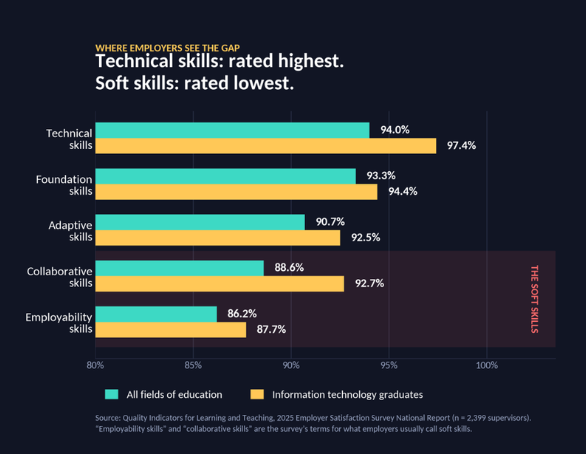
Each year the Quality Indicators for Learning and Teaching program asks the direct supervisors of recent graduates how satisfied they are. The 2025 results, released in March 2026, cover 2,399 supervisors.
Technical skills: 94.0 per cent satisfied. Employability skills — the survey’s term for soft skills: 86.2 per cent, the lowest of the five domains. For Information technology graduates the gap is wider: 97.4 per cent on technical skills, 87.7 per cent on soft skills.
Asked how the qualification could have better prepared the graduate, supervisors’ most common answer was employability and enterprise skills — 42.7 per cent, ahead of technical and professional skills at 34.9 per cent.
The teamwork evidence – from our own research
Students who rated their teamwork skills highly also rated themselves as more work ready. Teamwork accounted for 48 per cent of the variation in their sense of work competence and 57 per cent of their social intelligence — expressing themselves, communicating, building relationships.
Five things to do this semester
- Treat group assessments as the real thing. Own a defined task, agree deadlines out loud, flag problems early. This is the teamwork practice your degree actually gives you.
- Explain your work simply. After each assignment, write 150 words for someone with no background: what the issue is, why it matters, what happens next.
- Interrogate what AI gives you. Ask where the output is weakest, check the claim you would be embarrassed to get wrong, and never submit something you could not defend in a meeting.
- Frame the question before reaching for the tool. Write down what you are actually trying to find out. Most bad analysis is a good answer to the wrong question.
- Ask one feedback question. “What is one thing I could improve in how I communicate or contribute to a team?” Then act on the answer.
Turn the skill into evidence
Claiming a soft skill proves nothing — everyone writes “excellent communication skills”. Describe the action and the result.
|
Instead of this… |
Write this… |
|
Excellent communication skills |
Presented a cyber security risk assessment to a non-technical audience, translating vulnerabilities into prioritised recommendations |
|
Strong teamwork |
Collaborated in a four-person team to design and test a data dashboard, coordinating task allocation across project milestones |
|
Good critical thinking |
Identified a flawed assumption in an AI-generated analysis, verified the source data, and corrected the model before submission |
The short version
Your degree builds what you know. Soft skills decide what anyone can do with it — and AI has raised their price, not lowered it.
ONE LAST NUMBER
In the same survey, supervisors rated graduates’ preparedness for the job at 94.9 per cent. The graduates rated themselves at 86.4 per cent. If you are worried you will not be ready, the people who hire graduates disagree with you.
Sources:
- World Economic Forum, The Future of Jobs Report 2025 — Skills Outlook.
- Lee, H.-P. et al., The Impact of Generative AI on Critical Thinking, Microsoft Research and Carnegie Mellon University, CHI 2025.
- Quality Indicators for Learning and Teaching, 2025 Employer Satisfaction Survey National Report (March 2026).
- Griffin, A. & Vernon, L., Assessing the Role of Teamwork Skills in Cyber Security Graduates’ Perceived Work Readiness, Cyber Security Cooperative Research Centre.
- Jobs and Skills Australia, Australian Skills Classification.
TEQSA: PRV14332 | CRICOS: 04102F
www.adci.edu.au
marketing@adci.edu.au
admissions@adci.edu.au
