
Dr Anna Griffin | June 2026
How to build a personal brand that opens doors in cyber security and data science
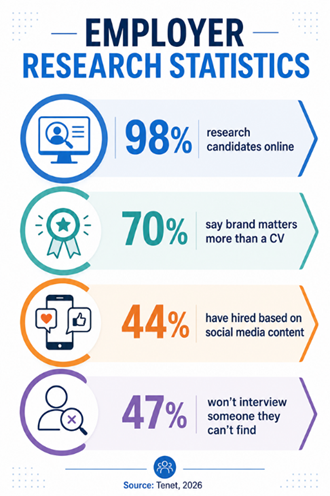
Before you hand in your first job application, something has already happened: your future employer has Googled you. They’ve checked your LinkedIn, scanned your GitHub, and formed an opinion before a single word of your resume has been read. According to employer surveys compiled by Tenet (2026), 98% of employers research candidates online before deciding whether to interview them, and 47% are less likely to call someone they cannot find at all. In a field as competitive as cyber security and data science, your digital presence is not a bonus, it is part of your application.
What Is a Personal Brand, Really?
Personal branding is not a polished performance or a LinkedIn profile stuffed with buzzwords. Gorbatov, Khapova and Lysova (2018) define it as “a strategic process of creating, positioning, and maintaining a positive impression of oneself, based on a unique combination of individual characteristics which signal a certain promise to the target audience.” In plain terms: it is the professional version of you, clearly communicated to the people who can give you a career.
There is a useful distinction worth keeping in mind. Your professional identity is who you are including your strengths, values and interests. Your personal brand is how effectively you communicate that identity. You need the first before you can build the second. Deloitte Australia’s Graduate Talent Acquisition team put it simply: “Your personal brand is your professional reputation. It’s how people describe you when you’re not in the room.”
Why It Matters More in Tech?
The labour market for cyber security and data science graduates is growing fast. Jobs and Skills Australia (2025) projects 14.2% employment growth in ICT security and database roles by 2029, more than double the national average of 6.6%. But growth in opportunity does not mean a clear run. Employers have become far more specific about what they want.
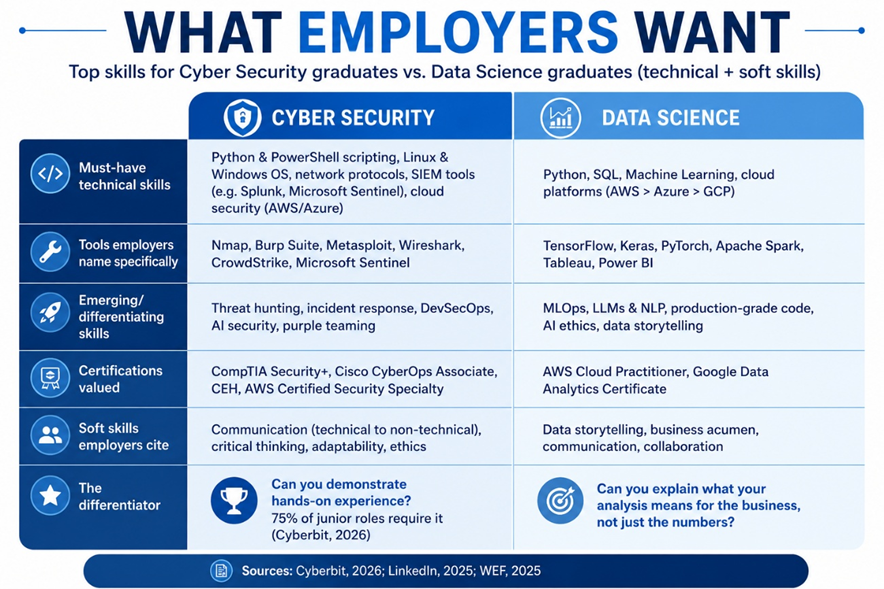
Cyberbit’s (2026) analysis of over 1,000 job postings found that 83% of cyber security roles explicitly require hands-on, demonstrable experience, including 75% of junior roles. The “entry-level” label no longer means what it used to. In data science, the World Economic Forum (2025) reports that roles combining advanced AI and data skills with communication, critical thinking, and ethical judgment are the fastest-growing globally. The technical skills get you through the door. The brand is what gets you the interview.
What You Can Do Right Now?
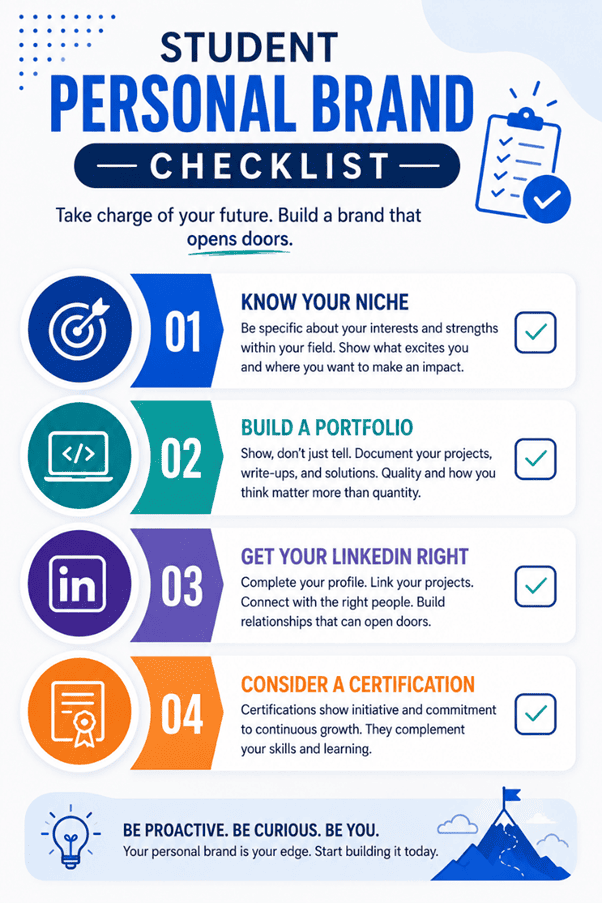
You do not need to wait until graduation to start building your brand. In fact, waiting is the wrong move. Here is where to begin:
- Know your niche. A candidate describing themselves as a “cyber security graduate passionate about ethical hacking and risk management” will stand out far more than “IT graduate open to opportunities” (Repério Human Capital, 2026). Even in your first year, start articulating what draws you within your field.
- Build a portfolio you can show. For cyber security students, this means documenting your work: home lab write-ups, CTF challenge solutions, vulnerability assessments, scripts. Platforms like TryHackMe and Hack The Box are excellent starting points, but the real differentiator is the quality of your write-ups, not the number of rooms completed. Hiring managers want to see how you think (TryHackMe, 2026). For data science students, publish notebooks on GitHub, enter Kaggle competitions and practise explaining your findings in plain language. Data storytelling is now a core skill, not a nice-to-have (LinkedIn, 2025).
- Get your LinkedIn right. Candidates with complete LinkedIn profiles are 40 times more likely to receive job opportunities (Tenet, 2026). Update it now. Link to your projects. Connect with peers, lecturers, and industry professionals. Twelve genuine interactions a week snowball into relationships and those relationships often lead to interviews that never hit the job boards (Merritt, 2025).
- Consider a certification. CompTIA Security+, the Google Cybersecurity Professional Certificate, or AWS Cloud Practitioner signal initiative and focused development. They do not replace experience, but they demonstrate you are investing in your professional growth (BAU, 2026).
Where ADCI Fits In?
Here is an advantage you may not have fully appreciated yet: your degree is already doing some of the heavy lifting.
ADCI’s Capstone program gives you exactly the kind of real, documented, industry-facing work experience that builds a credible professional brand before graduation. Through our partnership with Practera, Australia’s leading experiential learning platform, you work on genuine cyber security and data science projects for real industry clients. That is not a simulation. That is portfolio material.
When you sit in an interview and describe the problem you scoped, the approach your team developed, and the outcome you delivered for an actual client, that is your brand speaking. Gorbatov, Khapova and Lysova (2019) found in a study of 477 professionals that personal branding is positively and significantly related to perceived employability (γ = 0.61, p < 0.001) and that career satisfaction follows directly from that employability. Your Capstone experience is one of the most direct investments you can make in that outcome.
Your degree gives you the skills. Your brand communicates them to the world.
Start now
References
BAU (2026) What employers look for in cybersecurity graduates today. Available at: https://bau.edu/blog/what-employers-look-for-in-cybersecurity-graduates-today/
Cyberbit (2026) Same job, new skills: cybersecurity skills report 2026. Available at: https://www.cyberbit.com/cybersecurity-training/cybersecurity-skills-report-2026/
Deloitte Australia (2025) Graduate talent acquisition: personal branding advice. Deloitte Australia.
Gorbatov, S., Khapova, S.N. and Lysova, E.I. (2018) Personal branding: interdisciplinary systematic review and research agenda. Frontiers in Psychology, 8, p.2238. Available at: https://pmc.ncbi.nlm.nih.gov/articles/PMC6258780/
Gorbatov, S., Khapova, S.N. and Lysova, E.I. (2019) Get noticed to get ahead: the impact of personal branding on career success. Frontiers in Psychology, 10, p.2662. Available at: https://pmc.ncbi.nlm.nih.gov/articles/PMC6913621/
Jobs and Skills Australia (2025) Australian labour market for migrants, October 2025. Available at: https://www.jobsandskills.gov.au/news/cyber-security-skills-demand-labour-market-evolves
LinkedIn (2025) April 2025 data science job market report: skills to get you hired. Available at: https://www.linkedin.com/pulse/april-2025-data-science-job-market-report-skills-get-you-hired
Merritt, M. (2025) Tips for graduating cybersecurity students. LinkedIn, June 2025.
Repério Human Capital (2026) Recruiter-approved personal branding tips for tech professionals.
Tenet (2026) Personal branding statistics 2026 [compilation].
TryHackMe (2026) How to use CTF challenges to build a cybersecurity portfolio. Available at: https://tryhackme.com/resources/blog/how-to-use-ctf-challenges-to-build-a-cybersecurity-portfolio
World Economic Forum (2025) Future of jobs report 2025. Geneva: WEF.
TEQSA: PRV14332 | CRICOS: 04102F
www.adci.edu.au
marketing@adci.edu.au
admissions@adci.edu.au
